


Federal Regulations for Truck Accidents
Truck accidents in Miami and throughout Florida are often catastrophic, causing severe injuries and complex legal battles due to the size and weight of commercial vehicles. Unlike car accidents, truck accidents are heavily influenced by federal regulations, which set strict standards for drivers and trucking companies. These regulations, enforced by the Federal Motor Carrier Safety Administration (FMCSA), play a critical role in determining liability and building a case. At PWD Law Firm, our Miami truck accident lawyers leverage these regulations to hold negligent parties accountable and secure compensation for victims. This article explores key federal regulations, their impact on truck accident cases, and how we use them to fight for you.
Key FMCSA Regulations
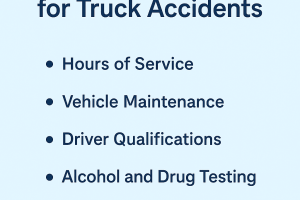
The FMCSA establishes comprehensive rules to ensure the safety of commercial trucks on roads like I-95 or near the Port of Miami. Hours-of-service (HOS) regulations are among the most critical, limiting how long drivers can operate to prevent fatigue-related accidents. As of 2025, drivers may drive up to 11 hours within a 14-hour on-duty period, followed by a mandatory 10-hour rest break. Electronic logging devices (ELDs) track compliance, but violations—such as falsifying logs to meet tight schedules—are common and can lead to crashes.
Vehicle maintenance rules require trucking companies to regularly inspect and repair their fleets, ensuring brakes, tires, and steering systems are in working order. Neglecting maintenance, like failing to replace worn brake pads, can cause accidents and expose companies to liability. Driver qualification standards mandate that drivers hold valid commercial driver’s licenses (CDLs), pass medical exams, and have clean driving records. Companies must verify these qualifications before hiring.
Cargo securement regulations ensure loads are properly secured to prevent shifting or falling, which can cause rollovers or collisions. Overloaded trucks, exceeding weight limits, are also prohibited, as they strain brakes and tires. PWD Law Firm examines compliance with these regulations to identify violations that contributed to your accident, strengthening your claim.
How Violations Affect Cases
Violations of FMCSA regulations often serve as powerful evidence of negligence in truck accident cases. For example, if a driver exceeds HOS limits and causes a crash due to fatigue, their ELD records can prove the violation, making them and their employer liable. Similarly, if a company fails to maintain a truck’s brakes, leading to a collision on the Palmetto Expressway, maintenance records can demonstrate negligence, justifying compensation for your injuries.
These violations can also lead to punitive damages in cases of gross negligence, such as a company knowingly allowing an unqualified driver to operate. Punitive damages punish egregious behavior and deter future violations, increasing your case’s value. However, proving regulatory violations requires access to specific evidence, like ELDs, inspection reports, or driver qualification files, which trucking companies may withhold or destroy. PWD Law Firm acts quickly to secure this evidence, ensuring it’s available to support your claim.
Florida’s comparative negligence law may reduce your compensation if you’re found partially at fault, but regulatory violations often shift blame to the driver or company. For instance, if a truck’s overloaded cargo causes a crash, we use cargo manifests to prove the company’s negligence, minimizing your liability and maximizing your award.
Challenges in Compliance
Despite clear FMCSA regulations, compliance remains a challenge for many trucking companies and drivers. Economic pressures drive some companies to prioritize profits over safety, pushing drivers to exceed HOS limits or skip maintenance to meet delivery deadlines. Smaller companies may lack the resources to train drivers properly or maintain fleets, increasing accident risks. Driver shortages can lead to hiring unqualified or inexperienced drivers, who may struggle to navigate Miami’s congested roads.
Technology gaps also pose issues. While ELDs improve HOS compliance, some drivers tamper with devices to hide violations. Similarly, outdated maintenance practices can miss critical issues, like worn tires, that only manifest during high-speed travel. These challenges create opportunities for negligence, but they also provide avenues for proving liability. PWD Law Firm’s thorough investigations uncover these compliance failures, holding companies accountable for endangering Florida residents.
How PWD Law Firm Uses Regulations
PWD Law Firm leverages FMCSA regulations to build compelling cases for truck accident victims. Our process begins with a free consultation to understand your accident and identify potential regulatory violations. We then collect evidence, such as ELDs, maintenance logs, and driver qualification records, to pinpoint non-compliance. For example, if a truck’s brakes failed, we obtain inspection reports to show the company neglected maintenance.
We collaborate with accident reconstructionists to link violations to the crash, demonstrating how fatigue or faulty equipment caused your injuries. Medical experts help us quantify damages, from immediate costs like surgeries to future needs like rehabilitation for a spinal injury. By tying regulatory violations to negligence, we strengthen your case for compensation, whether through settlement or trial.
Our attorneys are skilled at navigating the complexities of federal and Florida law, ensuring your claim is filed within the two-year statute of limitations (as of 2025). We negotiate with insurers to secure fair settlements, but we’re prepared to litigate if necessary to achieve the best outcome.
Get Legal Help Today
Federal regulations play a pivotal role in truck accident cases, and understanding them can make the difference in securing the compensation you deserve. PWD Law Firm’s experienced Miami truck accident lawyers use these regulations to prove negligence and fight for damages, including medical bills, lost wages, and pain and suffering. Whether your accident was caused by driver fatigue, poor maintenance, or improper cargo, we’re here to hold responsible parties accountable.
Don’t let time slip away. Florida’s statute of limitations gives you two years to file a claim, but acting quickly preserves critical evidence. Contact PWD Law Firm today for a free consultation to discuss your case and learn how we can help. Visit our contact page or call us to get started. Let us use our expertise to fight for your recovery and justice.
