


Truck vs. Rideshare Accidents: Who’s Responsible When Uber Meets an 18-Wheeler?
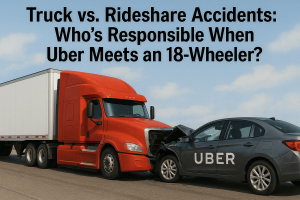
Collisions between rideshare vehicles (e.g., Uber/Lyft) and commercial trucks create complex liability scenarios due to multiple parties, overlapping insurance policies, and conflicting regulations. This article breaks down how fault is determined, key evidence, insurance challenges, and steps to protect your rights.
Contrasting Liability Frameworks: Trucking vs. Rideshare
Trucking Accident Liability
Commercial truck accidents are governed by federal regulations (FMCSA) and state laws. Potentially liable parties include:
- Truck drivers: Fatigue, speeding, or distraction.
- Trucking companies: Negligent hiring, maintenance failures, or Hours of Service (HOS) violations.
- Third parties: Cargo loaders, manufacturers, or maintenance crews.
Rideshare Accident Liability
Rideshare accidents involve tiered insurance coverage based on driver status:
- App off: Driver’s personal insurance applies.
- App on, no passenger: Rideshare company’s contingent coverage ($50k-$100k).
- Passenger in vehicle: $1 million commercial coverage.
Untangling Multi-Party Liability
Liability in truck-rideshare collisions often splits across multiple parties. Common scenarios include:
Scenario 1: Truck Driver at Fault
- Example: Truck driver’s fatigue causes a lane drift, hitting the rideshare vehicle.
- Liable parties:
- Truck driver (personal negligence).
- Trucking company (under respondeat superior).
- Cargo loaders (if improper securement contributed).
Scenario 2: Rideshare Driver at Fault
- Example: Uber/Lyft driver runs a red light, causing the truck to jackknife.
- Liable parties:
- Rideshare driver.
- Uber/Lyft (if driver was in Period 2 or 3).
- Other drivers (if shared fault).
Scenario 3: Shared Negligence
- Example: Truck driver is fatigued, and Uber driver is distracted.
- Liability apportionment: Determined by comparative fault rules (e.g., Florida reduces compensation by victim’s fault percentage).
Critical Evidence in Truck-Rideshare Collisions
Digital Evidence
- Truck black boxes: Record speed, braking, and engine data.
- Rideshare app logs: Confirm driver status (e.g., en route vs. offline).
- ELD logs: Verify truck driver HOS compliance.
Physical and Testimonial Evidence
- Accident reconstruction reports.
- Witness statements.
- Dashcam footage.
- Maintenance records for both vehicles.
Insurance Complications in Multi-Vehicle Crashes
Conflicting Policies
| Party | Typical Coverage Limits |
|---|---|
| Trucking Company | $750k-$5 million |
| Uber/Lyft | Up to $1 million |
| Personal Auto | State minimums (e.g., $10k) |
Claims Process Challenges
- Insurers dispute which policy applies first.
- Uber/Lyft may deny claims if the driver was offline.
- Trucking insurers use aggressive tactics to minimize payouts.
Protecting Your Rights After a Truck-Rideshare Crash
Immediate Steps
- Call 911 for medical and police response.
- Photograph vehicle damage, injuries, and road conditions.
- Collect witness contact information.
- Demand spoliation letters to secure truck black box data and rideshare app logs.
- Request Uber/Lyft trip records via legal subpoena.
Legal Strategy
- File claims against all potentially liable parties.
- Use digital evidence to counter insurer blame-shifting.
- Leverage FMCSA violations (e.g., HOS breaches) to prove negligence per se.
Preserve Critical Evidence
These cases require attorneys skilled in trucking regulations and rideshare insurance complexities. A specialized lawyer can:
- Identify all liable parties (e.g., cargo loaders, maintenance crews).
- Navigate multi-state jurisdiction issues.
- Negotiate with insurers to maximize settlements.
Conclusion
Truck vs. rideshare accidents demand meticulous investigation to untangle shared fault and overlapping insurance policies. Victims must act swiftly to secure evidence before it’s lost or destroyed.
Sources:
- Is Uber Responsible After an Accident? – CourtLaw
- Other Drivers’ Liability in Uber Accidents – The Super Lawyer
- What Makes an Uber Accident Different? – MSVerdict
- Truck Accident Liability Evidence – Promoting Justice
