


When Doctors Alter Records: Legal Strategies to Expose Tampering
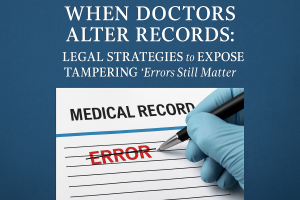
Medical records are supposed to be an objective, unalterable account of a patient’s care. But what happens when doctors—or other healthcare providers—alter those records after an adverse event? In Florida, record tampering is not only unethical but also illegal, and it can have devastating consequences for both patients and providers. This article explains how to detect altered records, the legal strategies for exposing tampering, and the penalties under Florida law.
Florida’s Electronic Record Audit Trail Laws
Florida Statute §766.1015 requires healthcare providers to preserve electronic health record (EHR) metadata, including audit trails that show who accessed or changed a record and when. The Florida Administrative Code 64B8-9.003 imposes penalties for failing to maintain accurate records or for making unauthorized changes.
Four Forensic Detection Methods
1. Time Stamp Analysis
Every EHR entry has a time stamp. In a Broward Health case, forensic analysis revealed that progress notes were entered two days after the patient’s discharge, raising questions about their authenticity.
2. User Login Tracking
Hospitals track which user ID is used to access or modify records. In one Miami case, a resident’s login was used to add notes after the attending physician had already signed off, suggesting unauthorized changes.
3. Version Comparison
Many EHR systems keep multiple versions of the same document. In an HCA Healthcare case, 17 different versions of a surgical consent form were discovered, each with slight but significant changes.
4. Printer/Fax Logs
Even in the digital age, paper records matter. Printer and fax logs can show when and what documents were printed, helping to reconstruct the timeline of care in cases where EHR data is missing or altered.
The Legal Nuclear Option: Spoliation Claims
When evidence is destroyed or altered, Florida courts can impose severe sanctions under the doctrine of spoliation. The Florida Standard Jury Instruction 401.23 allows juries to infer that destroyed evidence would have been unfavorable to the party responsible.
In a 2024 Tampa General Hospital case, the court imposed $3.8 million in sanctions after finding that key records had been deliberately altered.
The PWD Law Firm Approach
At PWD Law Firm, we work with forensic IT experts to:
Obtain and analyze EHR audit trails.
Compare multiple versions of key documents.
Subpoena device logs and printer records.
File motions for sanctions when tampering is detected.
Conclusion
Altering medical records is a serious offense with severe legal consequences. By using advanced forensic techniques and aggressive legal strategies, PWD Law Firm ensures that tampered records are exposed and justice is served for our clients.
